
Morocco housing aid refused: 8 mistakes that sink an application
Most direct housing aid applications in Morocco fail because a condition is not met, not because a form was filled in wrongly: the home is not eligible (occupancy permit issued before 2023, a resale, a price above MAD 700,000 including tax), the buyer already owns a home or has already received State housing support, or a deadline is missed at the notary's. The good news: almost all of this can be checked before you sign. Here are the 8 most common mistakes and how to avoid them, under the rules in force since the decree of 1 October 2026.

To give a sense of scale: at the end of September 2026, the programme had received more than 314,000 applications and paid around 128,000 aids (explanatory note to the 2027 draft finance law). Not every application reaches payment. Some are still in progress, but many get stuck on one of the points below.
Quick reminder: who is eligible and how much?
Direct housing aid ("Daam Sakane") is paid by the State towards the purchase of a new main residence. The programme runs from 2024 to 2028 and applications go only through the official platform daamsakane.ma.
| Home price (incl. tax) | Aid amount | Example | Left to finance |
|---|---|---|---|
| Up to MAD 300,000 | MAD 100,000 | Flat at MAD 280,000 | MAD 180,000 |
| MAD 300,001 to 700,000 | MAD 70,000 | Flat at MAD 450,000 | MAD 380,000 |
| Above MAD 700,000 | No aid | Flat at MAD 720,000 | MAD 720,000 |
The conditions published by the Housing Ministry cover three things: you (Moroccan nationality, resident or living abroad; not owning a home; never having received State housing support), the home (first sale, occupancy permit issued on or after 1 January 2023, at least two rooms, price no higher than MAD 700,000 including tax) and your commitment (living there as your main residence for 5 years, with a mortgage in favour of the State). For the programme in detail and its latest figures, see our article Direct housing aid in 2026.
The 8 mistakes that get the aid refused (or clawed back)
1. Signing the sale agreement before applying
This is the most expensive mistake. The official order is: you first apply on daamsakane.ma, you receive preliminary approval within 7 days at most, and only then do you sign the sale agreement (compromis) at the notary's. Signing and paying a deposit before knowing whether you qualify means you may be committed to a purchase without the aid.
What to do: application first, sale agreement second. Keep a screenshot of the preliminary approval.
2. Choosing a home that does not qualify
Many refusals come from the property, not the buyer. Three things rule a home out, whatever its price:
- an occupancy permit issued before 1 January 2023;
- a resale: only a home sold for the first time qualifies, older homes are excluded;
- fewer than two rooms.
For an off-plan purchase, the aid requires a finished home with its occupancy permit, so it cannot be paid before then (see our guide Buying off-plan in Morocco).
What to do: ask the seller or developer for a copy of the occupancy permit and check its date before signing anything.
3. Going over MAD 700,000, or crossing the MAD 300,000 line without noticing
Above MAD 700,000 including tax, there is no aid at all. And the MAD 300,000 threshold changes the maths a lot: a home at MAD 300,000 gets MAD 100,000 of aid (MAD 200,000 left to pay), while a home at MAD 310,000 gets only MAD 70,000 (MAD 240,000 left to pay). The second one costs MAD 40,000 more for a MAD 10,000 difference in price.
Another trap: paying part of the price "under the table" to stay below a ceiling. It is illegal, you lose any proof of what you paid, and the aid can be called into question.
What to do: think in prices including tax and in "amount left to pay after aid", not just the advertised price.
4. Already owning a home (without realising it)
Owning a home in Morocco ends your entitlement. The classic case: a flat bought years ago, or a property registered in your sole name. Checks are made directly with the administrations, so a simple declaration is not enough.
One thing changed with the 2026 finance law: people who only hold a share in undivided ownership (often a family property received through inheritance) can now receive the aid. That was not the case when the programme started. To check the status of a titled property, our article Land title, melkia, requisition explains how to read the documents.
What to do: review every property registered in your name before applying.
5. Having already received State housing support
The aid cannot be combined with a State housing benefit you have already received, and the same buyer can only get it once. The platform runs its own checks: do not rely on a seller who tells you that "an old benefit doesn't count".
What to do: if you have ever bought through a subsidised programme, even long ago, ask before you commit.
6. Missing the deadlines at the notary's
The process is a chain of short deadlines:
| Step | Maximum time |
|---|---|
| Preliminary approval after applying | 7 days |
| Notary files the sale agreement and occupancy permit on the platform | 7 days after drafting the agreement |
| Approval and payment of the aid to the notary | 15 days after the documents are filed |
| Signing the final sale deed | 60 days after the notary receives the aid (30 days before October 2026) |
Decree no. 2.26.578, published in the Official Bulletin on 1 October 2026, doubled that last deadline. If the final deed is not signed in time, the aid must be returned. When you borrow, the bank's approval is often the slowest link.
What to do: get your financing approved before the sale agreement. Our article on borrowing capacity helps you prepare the bank file.
7. Not going through a notary
Under the programme, the sale agreement must be drawn up by a notary: the notary files the documents on the platform and receives the aid, by cheque in the notary's name or by transfer. An agreement signed elsewhere cannot trigger the payment. Since law 41-25, a property sale must be made by authentic deed in any case.
Good to know: for homes of MAD 300,000 or less, the Secretary of State for Housing announced in 2024 that notary fees for the buyer would be capped at MAD 2,500.
8. Renting out or reselling too soon
A refusal can also come later, as a repayment. The home must remain your main residence for 5 years from the final deed (4 years before 2026). Reselling or renting it out before then means repaying the aid, which is secured by a mortgage in favour of the State.
After 5 years, the release of this mortgage is requested on the platform, with proof that you lived in the home. Since the decree of 1 October 2026, the managing body must process the request within 30 days at most.
Your checklist before applying
| To check | Where / how |
|---|---|
| I own no home in my sole name | Your own deeds, the land registry |
| I have never received State housing support | Your past purchase contracts |
| The occupancy permit dates from 2023 or later | Copy requested from the seller |
| It is a first sale, with at least 2 rooms | Seller / developer, floor plan |
| Price incl. tax ≤ MAD 700,000 (and where it sits against MAD 300,000) | Seller's written offer |
| Financing ready before the sale agreement | Bank's agreement in principle |
| I plan to live there for 5 years | Your own plans |
My application was refused: what now?
Start by reading the reason shown in your daamsakane.ma account. If it comes from inaccurate data (identity, a property registered in your name), it has to be corrected with the administration that holds it, because the platform relies on that information. If the home does not meet the conditions, the answer is to find another eligible property. For any specific situation (inheritance, undivided property, buying as a couple), a notary is the right person to ask.
FAQ
Why was my housing aid application refused?
Usually because a condition is not met: you already own a home, you have already received State housing support, or the property does not qualify (occupancy permit before 2023, resale, fewer than two rooms, price above MAD 700,000 including tax). The reason is shown in your daamsakane.ma account.
Is there an income ceiling for housing aid?
The conditions published by the ministry do not include one. The amount depends on the price including tax: MAD 100,000 up to MAD 300,000, MAD 70,000 from MAD 300,001 to MAD 700,000.
How long do I have to sign the final deed?
60 days from the notary receiving the aid, under decree no. 2.26.578 published in the Official Bulletin of 1 October 2026. It used to be 30 days. Without a final deed within that time, the aid must be returned.
Can Moroccans living abroad get the housing aid?
Yes, on the same conditions and for the same amounts as residents. See also our guide MRE: buying property in Morocco.
Can I rent out the home bought with the aid?
Not during the first 5 years: it must be your main residence. Renting or reselling before then means repaying the aid.
Sources
- Ministry of National Territorial Planning, Urban Planning, Housing and City Policy, direct housing aid programme
- Official platform
- Explanatory note to the 2027 draft finance law (figures at end-September 2026)
- LesEco, decree no. 2.26.578 of 22 September 2026 published in the Official Bulletin of 1 October 2026 (60 days, mortgage release within 30 days)
- Le360, 6 October 2026, deadline extended from 30 to 60 days
- Hespress FR, conditions and deadlines of decree no. 2.23.350 (7 days, 15 days)
- Hespress FR, 21 October 2025, 2026 draft finance law changes (5 years, mortgage release, co-owners)
- Le Matin, 2026 draft finance law: aid extended to owners in undivided ownership
- Le Matin, notary fees capped at MAD 2,500 (homes ≤ MAD 300,000)
This article is for information only and does not replace a notary's advice. The conditions that apply to your file are those shown on daamsakane.ma when you apply.
Looking for an eligible home? Browse properties for sale on Immofind, for example flats for sale in Casablanca, and check the price including tax and the date of the occupancy permit before you commit. To see where prices stand in your city, read our property price barometer.
Read also
Direct Housing Aid in Morocco: Where Things Stand in 2026
Launched in January 2024 and planned to run until 2028, Morocco’s direct housing aid programme helps households buy their main home. Here are the…
Morocco law 41-25: what changes when you buy or sell property
Since 16 July 2026, law 41-25 requires every property sale, every sale promise (the "compromis") and every power of attorney linked to them to be…
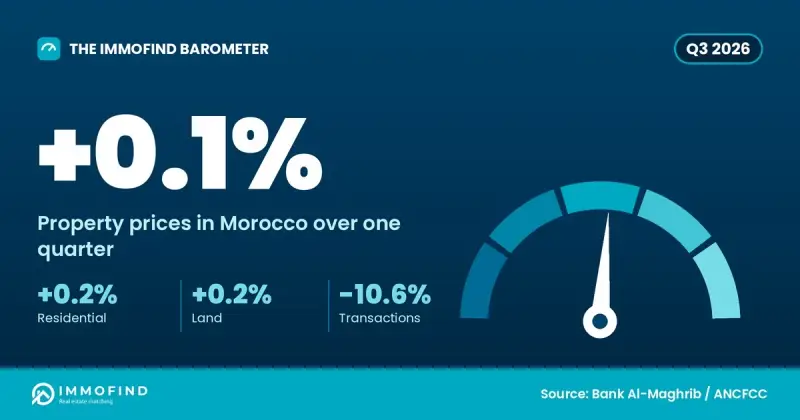
Morocco property price barometer (Q3 2026)
Updated 22 November 2026, based on the real estate asset price index (IPAI) no. 68 published by Bank Al-Maghrib and the ANCFCC on 20 November 2026.…
Looking for a property?
The Immofind match score shows you first the listings that match what you are looking for.